Paper Sizes
ISO 216 defines three main series of paper sizes: the A Series, B Series, and C Series. Each serves a different purpose — from everyday printing to specialised publishing and envelopes.
- ISO 216 is the global standard for paper sizes, used in most countries outside North America.
- The system is divided into A, B, and C Series — each serving a different purpose.
- A Series is the most common for everyday printing, with A4 being the standard office paper size.
- B Series sizes sit between A sizes and are often used for posters, books, and specialist printing.
- C Series is mainly for envelopes, designed to fit A-sized paper perfectly.
- All ISO sizes maintain a 1:√2 aspect ratio, allowing documents to scale up or down without changing layout or proportions.
- A0 is the largest A size; each size halves as the number increases (A1, A2, A3… down to A8).
- A4 fits:
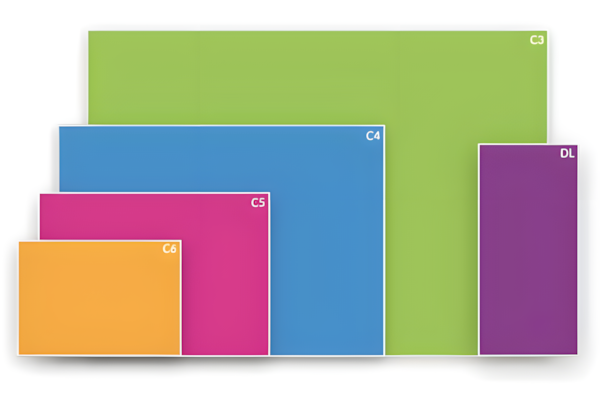
- C4 envelope unfolded
- C5 envelope folded once
- C6 envelope folded twice (to A6)


A Series
The unique feature of the A Series is that each size maintains the same aspect ratio of 1:√2 (approximately 1:1.414). This allows a sheet to be enlarged or reduced without distortion. For example, folding an A0 sheet in half along its shortest edge produces an A1 sheet, and this halving pattern continues all the way to A10.
The most widely used size in this series is A4 (210 × 297 mm) — the standard size for office and home printing.
A Series Size Guide
| Size | Width (mm) | Height (mm) | Common Uses |
|---|---|---|---|
| A0 | 841 | 1189 | Posters, architectural drawings, technical plans |
| A1 | 594 | 841 | Flip charts, large posters, presentation boards |
| A2 | 420 | 594 | Medium posters, diagrams, certificates |
| A3 | 297 | 420 | Drawings, large brochures, menus |
| A4 | 210 | 297 | Everyday printing, letters, magazines, forms |
| A5 | 148 | 210 | Notebooks, flyers, invitations, small booklets |
| A6 | 105 | 148 | Postcards, small leaflets |
| A7 | 74 | 105 | Tickets, vouchers, pocket notebooks |
| A8 | 52 | 74 | Business cards, coupons |

B Series
Each B size is based on the geometric mean of two consecutive A sizes. For example, B3 sits between A2 and A3. The B Series is also commonly used in industries such as publishing, printing, and artwork production where larger or non-standard sizes are required.
B Series Size Guide
| Size | Width (mm) | Height (mm) | Common Uses |
|---|---|---|---|
| B0 | 1000 | 1414 | Very large posters, signage |
| B1 | 707 | 1000 | Posters, wall charts |
| B2 | 500 | 707 | Medium posters, artwork prints |
| B3 | 353 | 500 | Documents, magazines |
| B4 | 250 | 353 | Envelopes, books |
| B5 | 176 | 250 | Notebooks, paperback books, diaries |
| B6 | 125 | 176 | Smaller books, leaflets |
| B7 | 88 | 125 | Tickets, labels |
| B8 | 62 | 88 | Small cards, badges |
C Series
without folding, or into a C5 envelope when folded once, and a C6 envelope when folded twice (to A6 size).
Like the B Series, C sizes are based on the geometric mean, but this time between the A and B Series, making them ideal for enclosing A-sized paper.
C Series Size Guide
| Size | Width (mm) | Height (mm) | Suitable For |
|---|---|---|---|
| C0 | 917 | 1297 | Fitting A0 sheets |
| C1 | 648 | 917 | Fitting A1 sheets |
| C2 | 458 | 648 | Fitting A2 sheets |
| C3 | 324 | 458 | Fitting A3 sheets |
| C4 | 229 | 324 | Fits A4 sheets unfolded |
| C5 | 162 | 229 | Fits A4 folded once (to A5) |
| C6 | 114 | 162 | Fits A4 folded twice (to A6) |
| DL | 110 | 220 | Standard business envelopes; fits A4 folded into thirds |
How the ISO 216 Paper System Works
Paper Types
- Two A4 sheets placed side by side equal the size of one A3 sheet.
- Reducing or enlarging prints keeps the layout proportional.
Easy Document Scaling
- A4 → A3 = 141%
- A4 → A5 = 71%
Global Usage
Frequently Asked Questions
A4 is narrower and longer (210 × 297 mm) than US Letter (216 × 279 mm). While A4 is used internationally for documents, US Letter is the standard in the U.S. and Canada. This difference can affect formatting, margins, and printer settings.
The 1:√2 ratio makes scaling simple. When you fold or enlarge paper, the proportions remain consistent, meaning documents can be resized without reformatting or distortion—a key advantage over North American sizes.
Most page-based digital formats—such as PDFs, Word docs, and print-ready artwork—use A4 as the default in ISO regions. Designers often create artwork in A-series dimensions to ensure accurate print output.
DL (110 × 220 mm) is the standard business envelope size. “DL” originally stood for “Dimension Lengthwise”, and it is designed to hold an A4 sheet folded into thirds.
- B Series provides more size options for printing, especially in publishing and signage.
- C Series is optimised for envelopes that perfectly fit A sizes, ensuring documents slide in without excess space or tight folding.
The largest commonly used ISO size is A0, but the system extends beyond that to 2A0 and 4A0 for extremely large printing. On the smaller side, the series can go down to A10, though sizes below A8 are rarely used.