Sustainability is now a major priority for UK businesses. With rising customer expectations and stricter environmental standards, every organisation is reassessing how marketing materials are produced. Leaflet printing continues to be an effective communication tool, but they are also an area where responsible choices can significantly reduce a brand’s environmental impact.
This article explains what sustainable leaflet printing involves, which certifications matter, how to choose environmentally responsible paper stocks and inks, and the true environmental footprint of leaflet production. It also provides practical guidance for running a greener print campaign.
Sustainable printing focuses on reducing environmental harm at every stage of the production process. Instead of limiting the concept to recycled paper, it considers:
Adopting these principles supports lower emissions, reduced waste and a more circular approach to print materials.
Verifiable certifications help businesses identify printers and materials that meet recognised environmental standards. They ensure sustainability is embedded in the production process, not added as a marketing claim.
The Forest Stewardship Council (FSC) certifies that paper fibres come from responsibly managed forests. Choosing FSC paper ensures traceability, supports biodiversity and protects workers and local communities.
ISO 14001 confirms that a business operates an environmental management system focused on reducing impact across operations. This includes energy use, waste management, emissions control and sustainable resource planning.
These initiatives measure emissions from the printing process and compensate through verified environmental projects. While reduction should always come first, offset schemes help neutralise unavoidable emissions.
Together, these certifications provide credible reassurance that leaflet production aligns with recognised sustainability standards.
Paper selection plays a central role in determining a leaflet’s environmental impact. Understanding the properties and benefits of different stock types helps businesses make informed decisions.
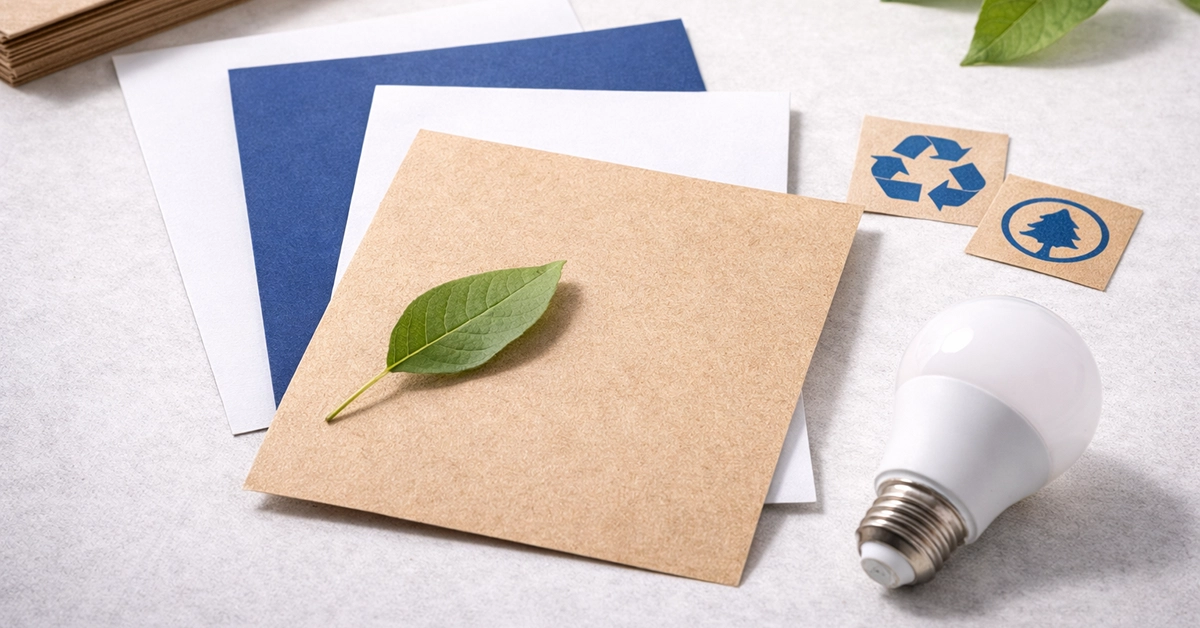
Made from post-consumer waste fibres, recycled paper supports resource efficiency and reduces reliance on virgin materials. Modern recycled stocks offer strong print quality, making them suitable for most marketing leaflets.
For projects requiring premium finishes or colour precision, FSC-certified virgin fibre provides reliability while still adhering to responsible sourcing standards.
Options such as bamboo or agricultural by-products are emerging as low-impact alternatives. Although not yet mainstream, they offer potential for future sustainable print solutions.


Ink composition and print processes also influence environmental performance.
Vegetable-based inks reduce reliance on petroleum products and release fewer volatile organic compounds (VOCs), making them more suitable for recycling and safer for the environment.
Digital printing helps minimise waste by enabling accurate short-run printing without lengthy setup processes. This is particularly useful for targeted leaflet campaigns.
Avoiding plastic laminates and choosing recyclable or biodegradable finishes improves a leaflet’s sustainability and supports easier recycling.
| Category | Best Practice | Why It Matters |
|---|---|---|
| Paper Stock | FSC-certified, recycled, alternative fibres | Reduces deforestation; supports responsible sourcing |
| Inks | Vegetable-based, low-VOC inks | Lower emissions; easier recycling |
| Print Process | Digital or efficient litho with waste controls | Minimises waste and energy use |
| Certification | FSC, ISO 14001, carbon-balanced schemes | Verifies genuine sustainability claims |
| Waste Reduction | Print appropriate quantities | Prevents unnecessary environmental impact |
| End-of-Life | Fully recyclable materials | Supports the circular economy |
To create sustainably, businesses must consider the entire lifecycle of printed materials.
Paper manufacturing is resource-intensive, requiring significant amounts of water and energy. However, modern European mills have improved sustainability through advanced water treatment, reduced emissions and responsible forest management.
Press operation and climate control contribute to emissions. Many environmentally conscious suppliers use renewable energy and energy-efficient machinery to reduce impact.
Traditional inks may contain petroleum-based solvents. Vegetable inks, with lower VOC emissions, help reduce pollution and support cleaner recycling streams.
Leaflet distribution adds to carbon output through travel miles. Consolidated delivery routes and local distribution options help keep emissions manageable.
Recyclability depends on paper type, ink composition and finish. Materials chosen with recyclability in mind ensure more fibres re-enter the recycling stream.
Digital alternatives are sometimes presented as automatically greener, but they carry environmental costs of their own, including device production and energy-hungry data centres. The most responsible choice depends on the campaign goals, audience and required formats.

Businesses can significantly improve the sustainability of their print marketing by:
Small adjustments across each stage of production can make a measurable difference.
Leaflets remain a powerful tool for local advertising, door drops, community messaging and event promotion. Physical materials can be particularly effective when targeting audiences who respond better to tangible content.
Digital channels, meanwhile, are suitable for fast updates, transactional communication and ongoing messaging.
A hybrid strategy allows print to be used where it has the most impact, while digital formats handle content better suited to online delivery. This reduces waste while maintaining campaign effectiveness.
Sustainable leaflet printing is entirely achievable when businesses make conscious choices about materials, processes and quantities. By selecting certified suppliers, using responsible paper stocks, reducing waste and considering recyclability at the design stage, organisations can maintain the effectiveness of their print campaigns while significantly reducing environmental impact.
If your business is planning a new leaflet campaign, now is an ideal time to rethink materials, review sustainability practices and adopt a print strategy that supports long-term environmental responsibility.

Unit 4-10 Stanton Road Ind. Est.
Stanton Road
Southampton
Hampshire
United Kingdom
SO15 4HU