Floor graphics play a vital role across UK workplaces, retail spaces, hospitality venues, public buildings, and educational settings. They guide customers, support branding, enhance navigation, and highlight safety messages. Yet because they sit directly underfoot, they must also be safe to walk on.
If a floor graphic lacks the correct anti-slip rating, it can increase the risk of slips and falls, especially in busy or moisture-prone environments. This guide breaks down what anti-slip ratings mean, how R9–R12 standards work, and how UK businesses can choose the right rating for their space.
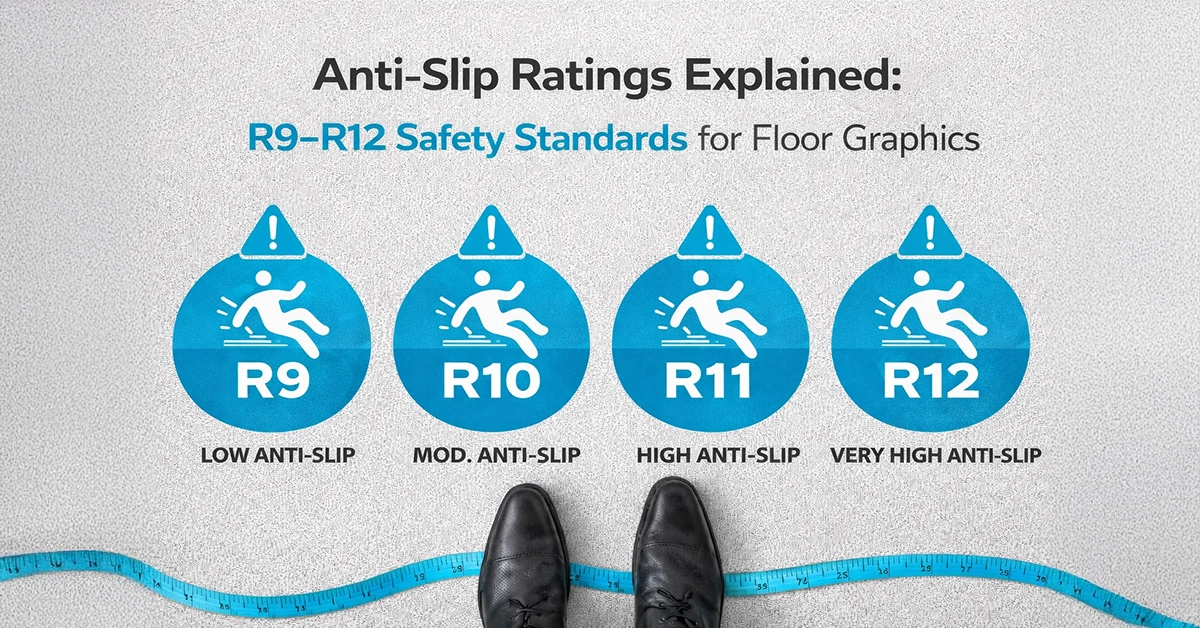
Anti-slip ratings classify how resistant a surface is to slipping when stepped on. The R-rating scale, ranging from R9 (lowest) to R12 (high slip resistance), is widely used in the UK and Europe to assess walkway safety.
Ratings are determined through controlled testing where a person walks across an inclined surface. The angle at which slipping occurs determines the R-rating. A higher rating indicates improved grip, particularly under wet or contaminated conditions.
For floor graphics, choosing the correct rating helps businesses reduce risk, meet safety expectations, and maintain compliance across public spaces.


Slip resistance testing typically uses the ramp method, where a test surface is evaluated to determine the angle at which a person begins to slip. Although technical, the principle remains simple: the steeper the angle without slipping, the safer the surface.
Key references include:
These tests must apply to the finished floor graphic, including lamination and adhesive, to ensure accuracy.
Floor graphics differ significantly from traditional flooring materials:
Additional risks such as cleaning residue, wet footwear, weather fluctuations, and spill hazards can further compromise grip. This makes a suitable R-rating essential for any graphic installed in a public or commercial space.
The ideal R-rating depends entirely on where the graphic will be installed. Choosing a rating that is too low increases risk, while selecting overly robust materials in low-risk areas can lead to unnecessary cost.
Below is a clear comparison table to support quick selection.
| Environment Type | Recommended R-Rating | Why This Rating Works |
|---|---|---|
| Dry indoor offices, meeting rooms | R9 or R10 | Minimal moisture and controlled conditions. |
| Retail aisles, shopping walkways | R11 | Varied footfall and frequent cleaning cycles require dependable grip. |
| Building entrances, public lobbies | R11 or R12 | Higher risk from rain, wet shoes, and temperature changes. |
| Cafés, restaurants, food-service areas | R12 | Spill risks and greasy surfaces demand strong slip resistance. |
| Warehouses, production floors, industrial use | R11 or R12 | Dust, oils, and heavy foot traffic require improved traction. |
Under the Health and Safety at Work Act, UK employers and facility managers must protect employees, customers, and visitors from avoidable risks. This includes ensuring that floor graphics do not contribute to slip hazards.
Key responsibilities include:
Failure to meet these responsibilities can lead to accidents, compensation claims, downtime, and damage to brand reputation.


Slip resistance is more than a technical detail; it directly affects safety. Consider the following examples:
Conversely, correctly rated graphics help prevent accidents, keep foot traffic moving smoothly, and provide reassurance during audits or inspections.
To ensure your graphics meet safety expectations, confirm the following before you buy:
These checks ensure long-term safety and support compliance across commercial environments.
Even high-rated graphics lose effectiveness without proper care. Good maintenance practices include:
These habits preserve the safety and appearance of your graphics while supporting compliance efforts.
Not every environment requires R12 slip resistance. For example:
The key is matching your slip rating to the actual risks in your location rather than automatically choosing the highest specification.
Anti-slip ratings are one of the most important considerations when selecting floor graphics. Choosing the correct R-rating, verifying certification, and maintaining the surface over time ensures your graphics remain safe, compliant, and effective in guiding people through your space.
If you are reviewing new floor graphic options, now is the ideal time to assess your environment, identify risks, and choose a product that aligns with both safety expectations and regulatory requirements.

Unit 4-10 Stanton Road Ind. Est.
Stanton Road
Southampton
Hampshire
United Kingdom
SO15 4HU