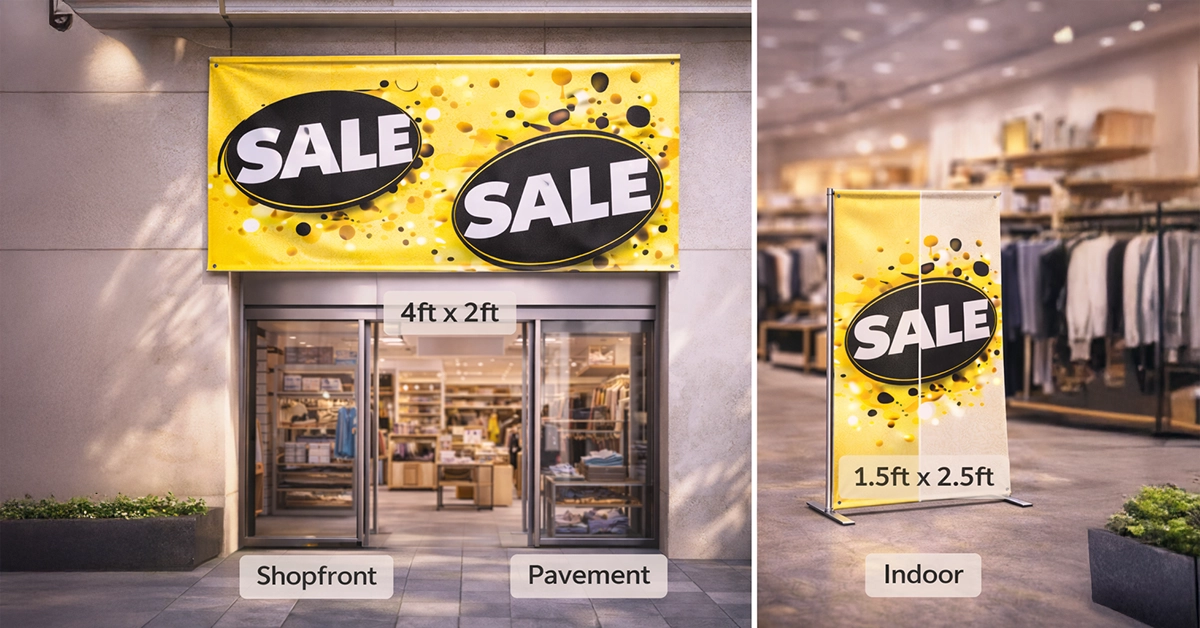
Choosing the right banner size is essential for any UK business aiming to improve visibility, attract customers and comply with local regulations. Even the strongest design can struggle to perform if the PVC banner is too small to notice or too large for the available space. The right dimensions ensure clear communication, strong street presence and practical installation.
This guide explores the best banner sizes for shopfronts, pavements and indoor environments across the UK. It includes visibility considerations, practical sizing advice and real examples to support confident decision-making.
Banner formats vary widely, and each environment requires a different approach. Before choosing dimensions, consider where your banner will be seen and how close your audience will be.
Each option has specific benefits, which is why the recommended sizes differ by setting.
Outdoor banners on a shopfront must grab attention from a distance while fitting neatly within the available façade. The most widely used size for UK retail spaces is the 3 m × 1 m PVC banner, offering strong visibility across busy streets.
If your shopfront shape or width is unusual, a custom banner size may suit your space better while still offering strong readability.
Pavement signage must catch the eye of passing foot traffic, support quick readability and comply with UK pavement safety guidance.
To ensure compliance, businesses should follow local pavement-display rules and maintain clear pedestrian pathways. You can review general UK advertising guidance on the official government here.


Indoor banners are usually viewed at close range, so dimensions focus on clarity and height rather than maximum surface area. Roller banners are among the most popular indoor formats because they stand tall, set up quickly and store compactly.
These banners also support high-resolution branding and concise messaging, making them ideal for point-of-sale promotions.
| Use Case | Recommended Sizes | Best For | Viewing Distance |
|---|---|---|---|
| Shopfront banners | 3 m × 1 m, 2 m × 1 m, 3 m × 1.2 m, 3 m × 1.5 m | High street promotions, façades, railing displays | Medium to long distance (10–30 m) |
| Pavement signage | A1, A0, A2 | Entrances, daily promotions, heavy footfall areas | Close range (1–5 m) |
| Indoor roller banners | 850 × 2000 mm, 1000 × 2000 mm, 1200–1500 × 2000 mm | Retail interiors, exhibitions, reception areas | Short range (1–3 m) |
| Desktop displays | A4, A3 | Counters, checkouts, reception desks | Immediate viewing (under 1 m) |
When selecting a banner, size should serve both your message and your environment. Use the following checklist to guide your decision.
By considering each factor, you reduce the risk of poor visibility or regulatory challenges.
Banner placements must remain safe, appropriate and compliant with UK advertising standards. While many temporary banners do not require planning permission, certain locations or formats may.
Consulting your local council’s signage guidelines ensures full compliance.


While standard formats suit most situations, some spaces require a bespoke approach. Custom sizing provides flexibility when traditional dimensions do not work.
Custom banners can enhance branding consistency and ensure your message fits perfectly within the available space.
Regardless of size, effective design is essential. A well-designed banner supports quick recognition and increases the likelihood of customer engagement.
Clear hierarchy, strong colour choices and balanced spacing ensure your banner performs as intended.
A clothing shop chooses a 3 m × 1 m banner above its main window to advertise a seasonal promotion, ensuring strong long-range visibility.
A café uses an A2 pavement sign to promote daily specials while keeping the walkway accessible during busy times.
A gym places an 850 × 2000 mm roller banner near its entrance to advertise membership offers, taking advantage of the tall, slim format.
These examples highlight how the right size supports both clarity and purpose in different environments.
The size of your banner plays a crucial role in how effectively your message reaches customers. By selecting dimensions that suit your environment, message and UK signage rules, you can create displays that perform consistently well.

Unit 4-10 Stanton Road Ind. Est.
Stanton Road
Southampton
Hampshire
United Kingdom
SO15 4HU