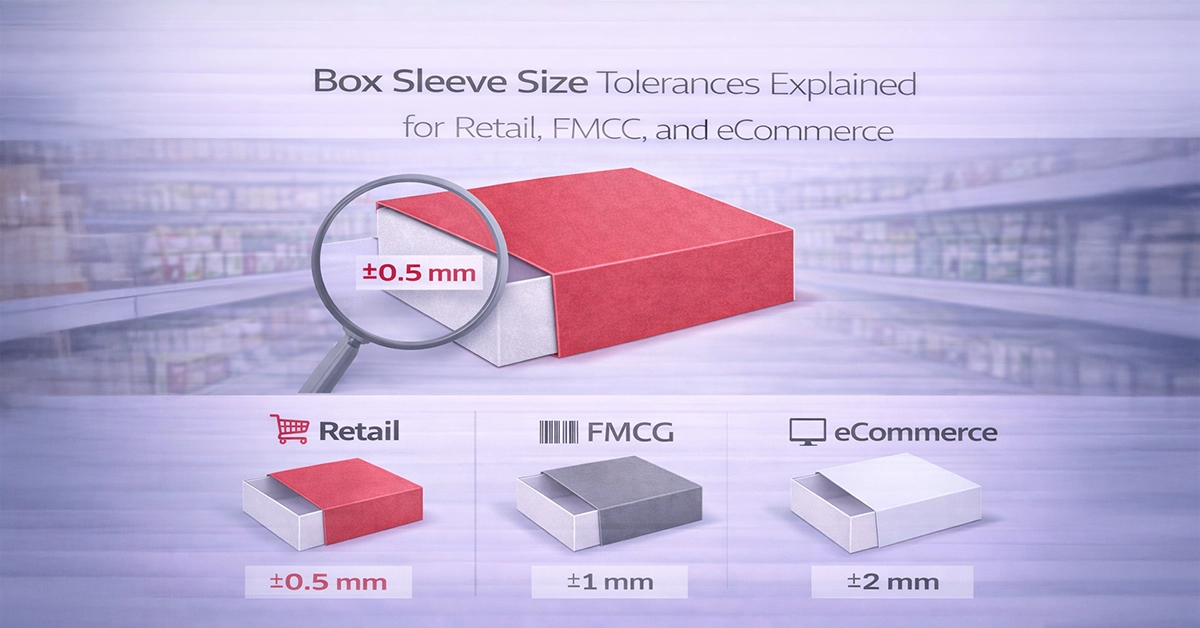
Box sleeve size tolerances are one of the most misunderstood aspects of printed packaging. Many businesses assume sleeves should fit perfectly every time, only to encounter problems such as slipping packs, tight application, wasted print runs, or delayed launches. In practice, size tolerances are not a flaw in packaging production. They are a built-in safeguard that reflects how printed materials are manufactured in the real world.
This guide explains what box sleeve size tolerances actually mean, why variation occurs, and how acceptable tolerance ranges differ across retail, FMCG, and eCommerce packaging. Understanding these principles early helps businesses reduce waste, avoid costly reprints, and specify packaging with far greater confidence.
Box sleeve size tolerances refer to the acceptable variation between the specified dimensions of a sleeve and the finished product produced during manufacturing.
Zero variation is not achievable in printed packaging. Paperboard is a natural material that responds to pressure, temperature, and humidity. As a result, small dimensional changes occur during printing, cutting, creasing, folding, and gluing.
A tolerance defines how much variation is acceptable without affecting performance or appearance.
For example:
Recognising this distinction prevents unrealistic expectations and reduces friction between design, procurement, and production teams.
Even when artwork and dielines are accurate, physical production introduces natural movement. Several stages of the process contribute to size variation.
Key factors include:
These factors are well understood across the UK print industry and are accounted for within standard manufacturing tolerances.
While exact tolerances depend on board choice, run length, and finishing method, the following ranges are widely accepted in UK packaging production.
Attempting to specify tighter tolerances than these ranges often increases cost and waste without delivering meaningful improvements in fit or appearance.
Tolerance expectations vary significantly depending on how and where packaging is used. Applying the same standards across all sectors often leads to problems.
Retail packaging
Retail sleeves are highly visible and must look consistent on shelf.
FMCG packaging
FMCG packaging must perform reliably on high-speed packing lines.
eCommerce packaging
eCommerce sleeves prioritise protection and durability during transit.
Incorrect tolerance planning leads to predictable operational and branding issues.
Over-tight sleeves:
Loose sleeves:
Misaligned sleeves:
While consumers may not understand packaging tolerances, they quickly notice when packaging looks or feels wrong.
Many sleeve-related issues stem from the same avoidable errors.
Each of these mistakes increases the likelihood of reprints, delays, and unnecessary cost.
The table below provides a quick reference for typical tolerance expectations across different sectors. This comparison is particularly useful when briefing designers, printers, or procurement teams.
| Sector | Typical Tolerance Range | Main Risk if Too Tight | Recommended Approach |
|---|---|---|---|
| Retail | ±1.5 mm to ±2 mm | Visual misalignment | Prioritise appearance and testing |
| FMCG | ±2 mm to ±3 mm | Line stoppages | Allow movement for automation |
| eCommerce | ±2.5 mm to ±3 mm | Transit damage or slippage | Focus on protection and durability |
Clear specification is the most effective way to avoid tolerance disputes and production issues.
When ordering box sleeves, provide:
Requesting prototypes or test samples before full production is strongly recommended, especially for new products or large-volume runs.
Poor tolerance planning is a common cause of:
Allowing realistic tolerances leads to:
In many cases, sensible tolerance planning delivers measurable cost savings without compromising quality.
Box sleeve size tolerances are not a minor technical detail. They are a fundamental part of successful packaging design and production.
When tolerances are understood and agreed early:
The most reliable packaging projects treat tolerances as a safeguard, not a compromise.
If you are planning printed box sleeves for retail, FMCG, or eCommerce, review your size tolerances before artwork is signed off. Speak with a packaging specialist, request physical samples, and ensure tolerance ranges are agreed at the outset. Addressing this early prevents costly issues later and leads to far smoother production.

Unit 4-10 Stanton Road Ind. Est.
Stanton Road
Southampton
Hampshire
United Kingdom
SO15 4HU